Wholehearted Faith or Divided Heart
Click here for the readings for - Wholehearted Faith or Divided HeartWholehearted Faith or Divided Heart
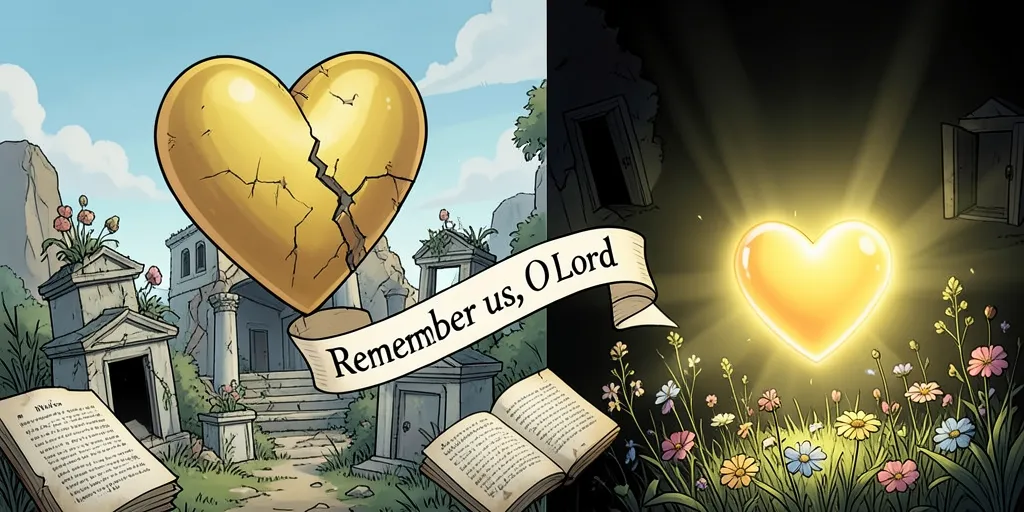
The Scriptures today place two hearts side by side: a king’s heart that slowly fractures and an outsider’s heart that tenaciously believes. Between them runs a plea from the psalm: “Remember us, O Lord,” and a whisper from James: welcome the word with humility. It is a portrait of what either makes us whole or leaves us divided.
The Slow Turn of the Heart
“When Solomon was old,” we hear, his heart had turned. Not in a single dramatic betrayal, but through accumulation; love after love, altar after altar; until the man who once asked only for wisdom no longer followed the Lord “unreservedly.” The tragedy is not simply moral failure; it is the sorrow of a diffused heart. Solomon builds “high places” for the gods of his wives. He sets up compromises, each one plausible, each one managing public peace, each one eroding interior truth. The cost is not immediate collapse but a kingdom quietly coming apart at the seams.
God’s judgment is real, yet even here it comes braided with mercy: for David’s sake, not all is lost, and not immediately. The Lord curbs the ruin. This is how divine justice works in a covenant; firm in truth, astonishingly patient in love.
Most of us do not wake up and renounce God. We drift. Our “high places” look less like shrines and more like habits: the phone that gets our first attention and our last; the success metrics that become absolutes; the ideologies that ask for moral exceptions; the private bitterness we accommodate. The split kingdom shows itself in our frayed relationships, our fatigue, our scattered will. Solomon warns us that the heart cannot serve several ultimates at once. What we repeatedly give our attention to will quietly enthrone itself.
A Psalm for the Age of Distraction
Psalm 106 laments a people who “mingled” and “learned their works,” until idols ensnared them. The psalm is not anti-culture; it is anti-captivity. When we absorb uncritically whatever is around us, we begin to call slavery freedom. The psalm’s most searing line remembers a society that “sacrificed their sons and daughters.” It names what happens when idols mature: they demand the future. In every age, children pay when adults enthrone false gods; when convenience devours commitment, when screens displace presence, when economies prize productivity over persons, when truth is trimmed so that reputation remains comfortable.
The refrain; “Remember us, O Lord”; is not a plea to jog God’s memory; it is our return to sanity. It is the prayer of people who realize they have forgotten themselves and now wish to be found.
Faith That Kneels and Reasons
Into this landscape steps a woman from Tyre, a Greek, a Syrophoenician; an outsider on every map. She has heard only rumors of Jesus, but love for her tormented daughter draws her across borders and thresholds. Jesus’ response sounds hard: the children must be fed first; it is not right to cast their food to dogs. He is voicing Israel’s vocation: the promise is given first to the children of the covenant so that, through them, all nations will be blessed.
The woman does not argue the order of salvation. She asks about the abundance of it. Even dogs, she says, eat the crumbs that fall from the table. In one sentence, she holds humility and audacity together. She accepts her place; she presses the Lord’s generosity to its logical end. If grace is real, then even the overflow will be enough. And it is. Jesus delights in her answer, and a demon flees at a distance.
Consider the contrast. Solomon had God’s appearances, temple, priests, choirs, throne; and his heart grew divided. This woman had hearsay and a shut door; and she found her way into mercy. One had privilege without obedience; the other, exclusion without despair. The Gospel insists: it is not proximity to religion that saves us but a surrendered, persevering faith.
Welcoming the Implanted Word
James urges: welcome the word planted in you with humility. Humility is not self-contempt; it is reality embraced. It recognizes who God is, who we are, and how to live inside that truth. Humility keeps the heart from splitting because it refuses to negotiate with idols. It receives, instead of curates, the Word. It lets the Lord’s truth rearrange our loves so that they are ordered, not scattered; invited, not coerced; fruitful, not consuming.
In practice, welcoming the Word rarely feels dramatic. It looks like showing up when prayer feels arid; confessing the sin you’ve grown used to excusing; blessing the person you are tempted to reduce to a label; letting Scripture contradict you before you quote it to correct someone else; kneeling with the Syrophoenician woman until your clever arguments become simple petitions for mercy.
From Scarcity to Superabundance
Both Solomon and the woman face a kind of scarcity test. Solomon fears losing the love of his many alliances; he spreads his worship thin to keep every table set. The woman faces the scarcity of place; last in line by every measure; and bets everything on divine abundance. She believes there is enough in God for her child too. That is the hinge: idolatry fixes on limits and grasps; faith fixes on the Giver and receives.
Where, today, does the fear of not having enough; enough security, enough approval, enough control; push your heart toward small bargains that fracture your integrity? And where might the Lord be asking you to risk the bold prayer that sounds, at first, like too much: “Even the crumbs, Lord, will be enough for my house”?
Practicing a Wholehearted Faith
- Identify one “high place” you’ve built; an attachment that quietly competes with God. Dismantle it this week with a concrete act: delete an app, set a boundary, decline a compromise.
- Pray the psalm’s refrain daily: “Remember me, O Lord, as you show favor to your people.” Let it become a breath prayer that gathers your scattered attention.
- Humbly welcome the Word: choose a short passage from the day’s Gospel and sit with it for ten minutes, allowing it to read you before you read it.
- Intercede like the Syrophoenician woman for one person; especially a child or someone who feels outside. Persist without polish.
- Make room at your table for someone on the margins of your life: a coworker no one notices, a neighbor you avoid, a family member you’ve sidelined. The kingdom’s abundance grows where hospitality opens space.
Solomon teaches that a divided heart loses its kingdom; the woman shows that even crumbs from the true King overturn the reign of darkness. Today is a day to ask for a single heart; steadfast, humble, and bold; one that lets the implanted Word take root until it bears the peace that no idol can counterfeit and no scarcity can exhaust. May the Lord remember us; may we remember Him.