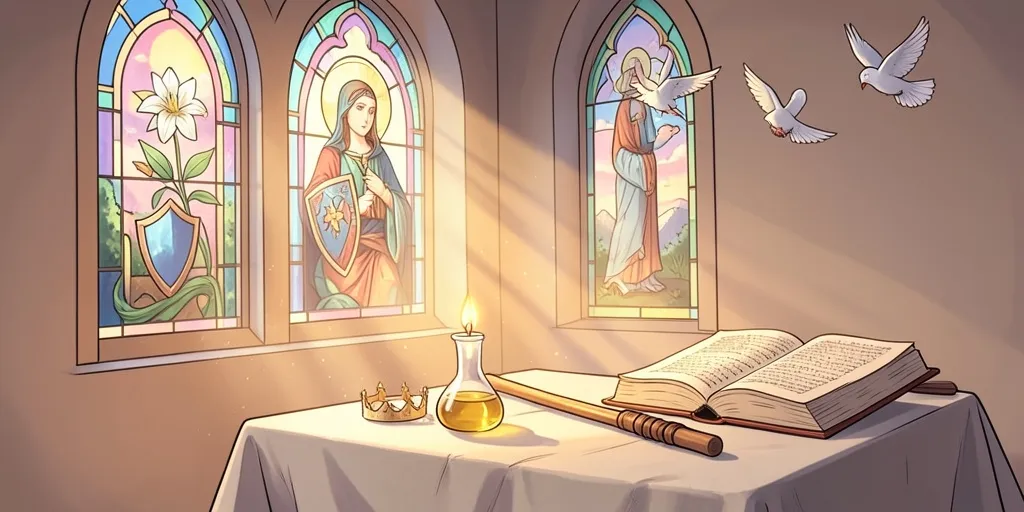
Courage, Simplicity, and Fidelity
Click here for the readings for - Courage, Simplicity, and FidelityCourage, Simplicity, and Fidelity
There is a quiet clarity in today’s readings: a dying king handing on wisdom, a psalm that steadies the heart in God’s sovereignty, and a Messiah who sends ordinary people into a world that aches for liberation and healing. On the Memorial of Saint Agatha, Virgin and Martyr, the Word draws together courage, simplicity, and fidelity; a way of living that is both bracing and tender in a culture often animated by fear, grasping, and noise.
A Father’s Last Words: Strength as Fidelity
David’s charge to Solomon is not the myth of bravado; it is the marrow of biblical strength. “Take courage and be a man” is immediately defined as keeping the Lord’s ways “with whole heart and whole soul.” In Scripture, maturity is not measured by dominance or dazzling achievement, but by covenantal fidelity; staying oriented to God’s commands when power, pressure, or pain would invite compromise.
Most inheritances in our world revolve around status, wealth, or reputation. David hands on something else: a path. The stability of Solomon’s throne, Scripture insists, will flow not from clever alliances or iron-fisted control, but from a heart that stays turned toward God in the concrete patterns of daily obedience. The same holds for us. The future we long for; whether in family, work, or society; cannot be secured merely by strategy; it must be stewarded by integrity.
“Yours, O Lord, Is the Sovereignty”
The responsorial psalm relocates the center of gravity: grandeur, power, riches, and honor are God’s to give and God’s to take. That is not a line meant to diminish human effort; it is meant to liberate it. When everything is ultimately received rather than seized, ambition can become generous, leadership can become service, and success can be held with an open hand.
There is a paradox here. Surrender to God’s sovereignty does not make a person passive. It makes a person free. Free from the tyranny of outcomes, free from the compulsions of comparison, free to act boldly without needing to control every variable. Holiness, then, is courageous cooperation with grace, not anxious micromanagement of life.
Sent Two by Two: Poverty, Presence, and Authority
Jesus sends the Twelve into the world with a staff, sandals, and a startling lack of backup plans. No extra tunic. No emergency provisions. The instruction is not a stunt in asceticism; it is pedagogy. He trains them to trust the Father’s care and to discover that the Church’s authority does not spring from splendid gear or thick wallets, but from the name and compassion of Christ.
- Poverty: Carrying less can make room for more; more dependence on God, more availability to people, more peace in the heart. The mission tells us to travel light not to deny needs but to resist illusions about what truly empowers love.
- Presence: “Stay in the house where you are welcomed.” Rootedness allows depth. In a culture of perpetual scrolling and restless hopping, the Gospel commends faithful presence. Healing often happens not through a hundred dramatic gestures but through one consistent one.
- Authority: The apostles are not therapists or magicians; their authority is received. They preach repentance; the realignment of one’s life toward God; and they anoint the sick with oil. Spiritual and bodily wounds both matter to Jesus. The Church’s mission is sacramental and concrete: conversion and care belong together.
And there is the sober instruction to “shake the dust” where the message is rejected. It is a call to interior freedom and boundaries. Not every heart will open today. The disciple may grieve but is not to be paralyzed. Rejection is not the end of mission; it is part of its landscape.
Saint Agatha: Integrity Stronger Than Violence
Today the Church honors Saint Agatha, a young woman from third-century Sicily who suffered martyrdom under the Decian persecution. Tradition remembers her as courageous, steadfast in consecrated virginity, and subjected to brutal assaults including mutilation. She entrusted her body and future to Christ, refusing to be coerced by political power or personal predation. In her, the Church recognizes that bodily integrity, chastity, and dignity are not fragile ideals; they are radiant truths worth living and, if necessary, dying for.
Agatha is invoked as a patron for those with breast cancer and for survivors of sexual violence. Her witness does not romanticize suffering; it unveils the deeper sovereignty of God in the face of injustice. Agatha’s “no” to evil was anchored in a larger “yes” to Love. She shows that Christian purity is not a timid retreat but a luminous freedom: the freedom to belong wholly to God, to resist dehumanization, and to become a sheltering intercessor for the wounded.
There is a quiet consonance between the Gospel and Agatha’s memory: the apostles anoint the sick with oil; Agatha’s wounds become places of intercession and healing for others. The Church’s response to violence and illness is not denial, but presence: prayer, protection, advocacy, and care. Honoring Agatha today means recommitting to safeguarding the vulnerable, supporting survivors, and defending the sanctity of every body.
Living the Harmony: Courage, Simplicity, Mercy
Bring the readings and Agatha together and a pattern emerges:
- Courage is fidelity under pressure.
- Authority flows from God, not gear.
- Freedom is found by traveling light and setting healthy boundaries.
- Mission integrates proclamation and healing; it calls to repentance and it anoints wounds.
- Sanctity is not escape from the world’s pain but the transfiguration of it through love.
For many, today’s battlefield is less courtroom or coliseum and more inbox, clinic, kitchen table, or hospital ward. Anxiety over bills, loneliness after a breakup, a parent’s decline, a diagnosis that reshapes a future, the sting of online cruelty; these are the places where the Lord still sends disciples two by two. The walking stick may be a friend’s steadying presence. The oil may be a listening ear, a meal dropped on a doorstep, a ride to an appointment, a boundary that protects a vulnerable heart, or the Sacrament of the Anointing given by a priest. The authority over unclean spirits may look like saying no to shame, addiction, exploitation, and despair; by the power of the name of Jesus.
Practices for the Journey Today
- Pray David’s inheritance: “Lord, keep my heart whole toward you.” Name one area to obey God concretely this week.
- Travel lighter: Remove one unnecessary “extra tunic” you rely on for security; an unhelpful habit, a device at bedtime, a purchase that masks anxiety; and offer that space to God.
- Go two by two: Choose a companion in Christ. Share one struggle and one grace. Pray for each other by name.
- Stay where you are welcomed: Identify the few relationships or communities where God is clearly at work. Invest there with steady presence.
- Shake the dust: Release one rejection or past failure into Jesus’ hands. Ask for the freedom to move on without bitterness.
- Anoint with care: Visit someone who is sick, lonely, or grieving. If appropriate, invite a priest for Anointing or Confession. Support a local shelter or advocacy group that serves survivors of abuse.
- Ask Saint Agatha’s intercession: for courage to guard the dignity of every person, for healing of those battling breast cancer, and for protection and justice for survivors of sexual violence.
David teaches inheritance as fidelity. The psalm returns us to God’s throne. Jesus sends us light and together. Agatha shows that the human body, entrusted to God, cannot be finally mastered by violence. May we receive this harmony as our map: to live with whole hearts, to speak the truth with tenderness, to bear rejection without rancor, to anoint wounds with hope, and to travel simply and bravely in the sovereignty of God.